St. Vitus Cathedral, Prague — The Complete Guide
Six hundred years of Gothic architecture, the tombs of Bohemian kings, Alfons Mucha’s stained glass and the Bohemian Crown Jewels — everything you need to understand what you are looking at
St. Vitus Cathedral is inside Prague Castle — entry is included with the Prague Castle ticket (Circuit A, CZK 250). Open daily: April–October 9am–5pm, November–March 9am–4pm (Sundays from noon). The cathedral took 585 years to complete — begun in 1344, consecrated in 1929. Allow 45–90 minutes. Do not skip the St. Wenceslas Chapel, the Mucha window, or the Royal Crypt below the nave.
Six Hundred Years of Construction
No other cathedral in Europe took as long to build as St. Vitus. The story begins not in 1344 but in 929, when Prince Wenceslas — later canonised as the patron saint of Bohemia — built a small Romanesque rotunda on the Hradčany hilltop to house a relic of St. Vitus received from the Saxon Emperor Henry I. The church grew with the importance of Prague: a basilica replaced the rotunda in 1060, and finally, in 1344, King Charles IV — the most ambitious ruler Bohemia ever produced — decided the city deserved a Gothic cathedral to rival anything in France or Germany.
What followed was not a single continuous construction project but a series of interrupted efforts spanning seven centuries, shaped by wars, fires, political disruption and changes of architectural fashion. The result is a building that is simultaneously Gothic, Renaissance, Baroque and Neo-Gothic — a cathedral that carries the entire history of Bohemia in its stones.
The Architecture — What You Are Looking At
St. Vitus is not a unified architectural statement. It is a conversation between four different eras of European building — and understanding the dialogue makes the building significantly more interesting than seeing it as a single Gothic mass.
Simplified floor plan — not to scale. The cathedral is oriented east–west: the choir (Gothic original) faces east, the nave (Neo-Gothic addition) faces west toward the castle entrance.
The Gothic Choir — Peter Parler’s Masterwork (1352–1420)
The choir — the eastern half of the cathedral where the altar stands — is the original Gothic construction. This is where you see Parler’s genius most clearly. His net vaulting distributes weight along a web of stone ribs rather than along a single central spine, creating a ceiling that appears weightless despite being made of stone. Look up in the choir: the ribs fan out from the pillars like a stone forest canopy.
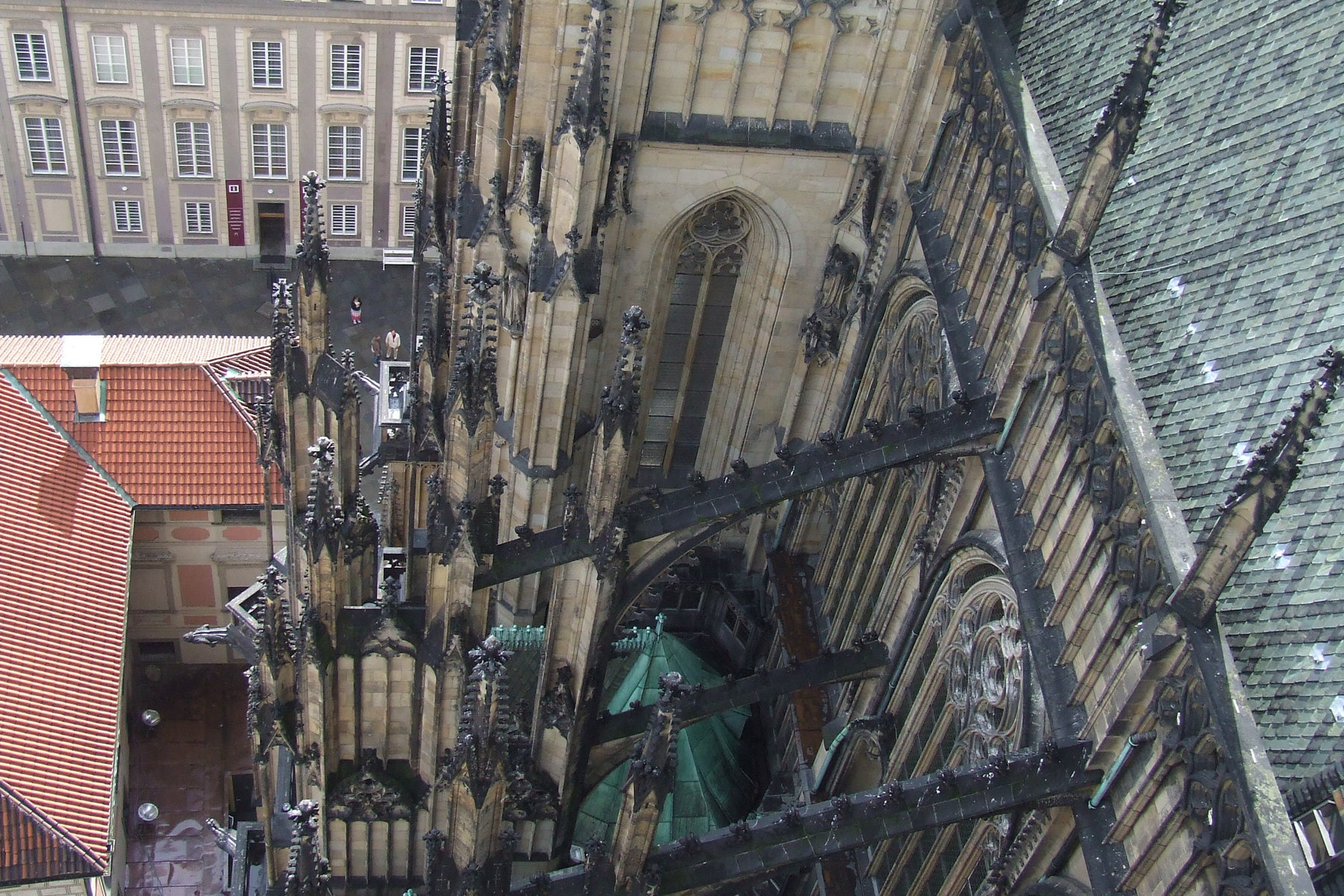
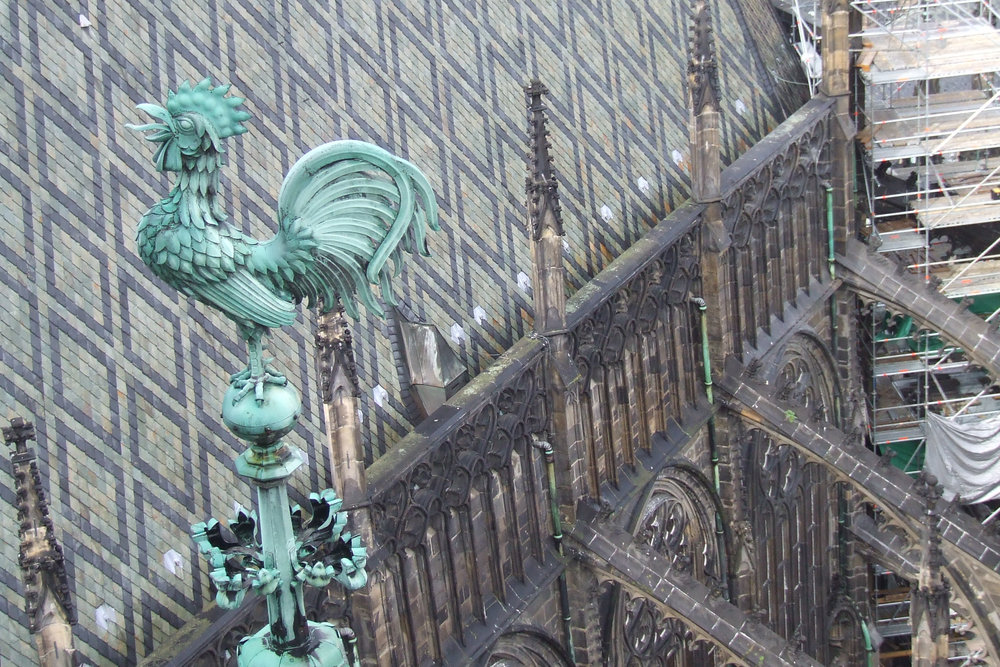
The flying buttresses on the exterior are both structural and aesthetic — they transfer the lateral thrust of the vaulted ceiling to outer piers, freeing the walls to be filled with stained glass instead of carrying load. Walk around the outside of the cathedral, past the choir end, and look at how the buttresses arch over the chapels like stone bridges. This is Gothic engineering at its most articulate.
Parler’s innovations at St. Vitus were not merely decorative. His net vaulting system — developed here for the first time — influenced Gothic architecture across Central Europe for the next century. Some British architectural historians believe his work at St. Vitus may have influenced the development of the Perpendicular style in English Gothic. He is buried in the triforium he designed. His portrait bust, alongside those of Charles IV and the cathedral’s other builders, hangs in the gallery above the choir — the first known architect self-portrait in Central European history.
The Neo-Gothic Nave — Faithful Imitation (1873–1929)
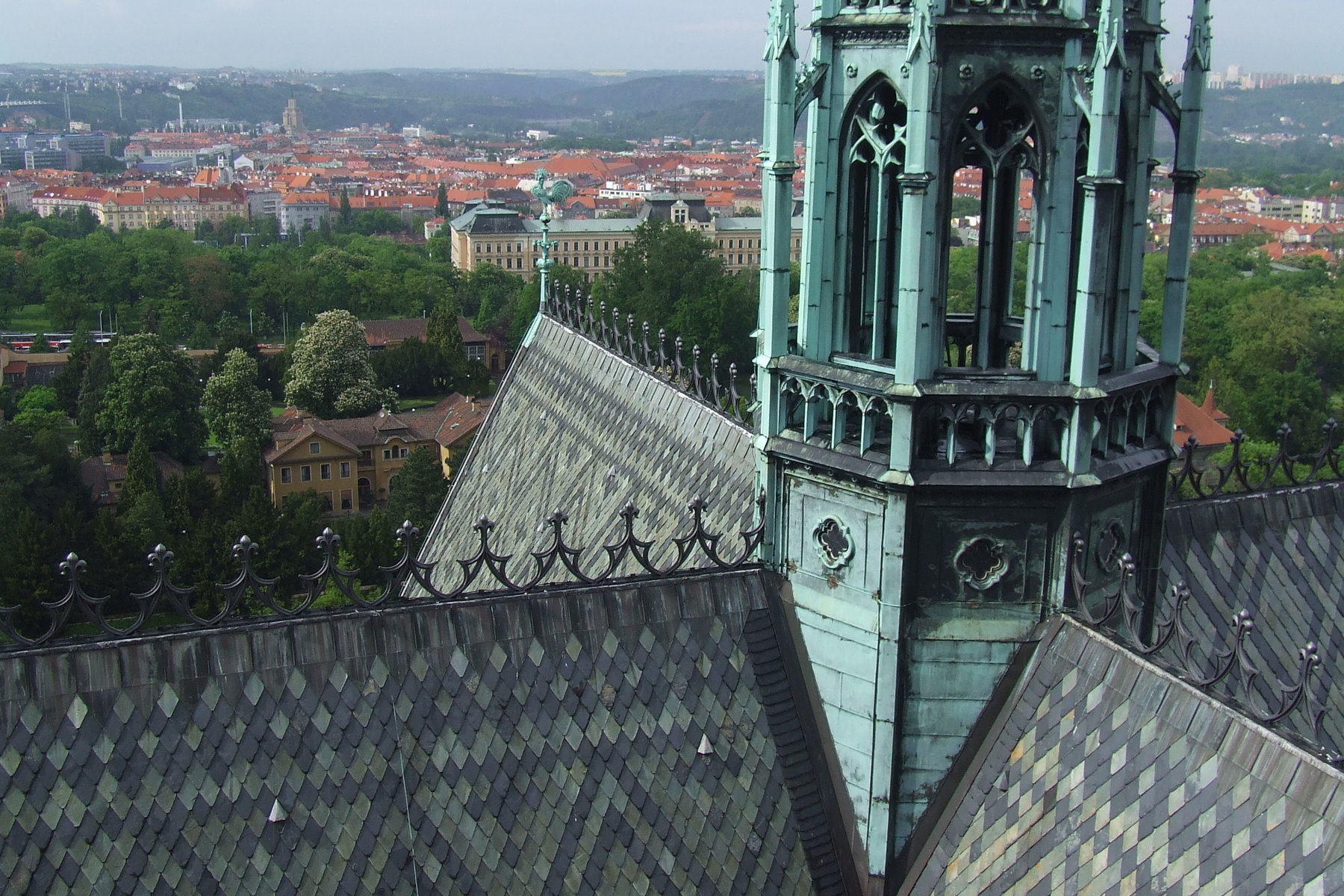
The western half of the cathedral — the nave, transept and twin west towers — is Neo-Gothic, built between 1873 and 1929 by Josef Mocker and Kamil Hilbert. The brief was to complete the cathedral in a style that would be indistinguishable from the 14th-century original. They succeeded to a remarkable degree: standing in the nave and looking toward the choir, the join is almost invisible.
The difference becomes apparent in the detail. Parler’s original Gothic is three-dimensional, sculptural, inventive — his stone surfaces are carved with portraits, animals, grotesques. The Neo-Gothic nave is more regular, more academic, competently executed but without Parler’s restless imagination. The stained glass windows in the nave, however, are extraordinary — see the Mucha window below.
The Great South Tower — Three Styles in One
The tower that dominates the Prague skyline is a palimpsest of European architectural history. The lower section is Gothic, begun by Peter Parler in the 14th century. The middle section — with its Renaissance gallery — was added after the 1541 fire. The Baroque dome at the top was added in the 17th century. You can read the tower like a timeline: Gothic ambition at the base, Renaissance pragmatism in the middle, Baroque grandeur at the top. The tower is 97 metres tall. The 287 steps to the top reward visitors with one of the best views in Prague.
Prague Castle complex overview — not to scale. The cathedral dominates the Third Courtyard. Enter from the west (First Courtyard) and the cathedral is directly ahead. Golden Lane and the Old Royal Palace are east of the cathedral.
What to See Inside — A Room-by-Room Guide
Most visitors spend 20 minutes inside St. Vitus Cathedral and leave without seeing the most important things. The cathedral rewards attention. Here is what to look for, in the order you encounter it moving from the entrance toward the altar.
The West Façade — Before You Enter
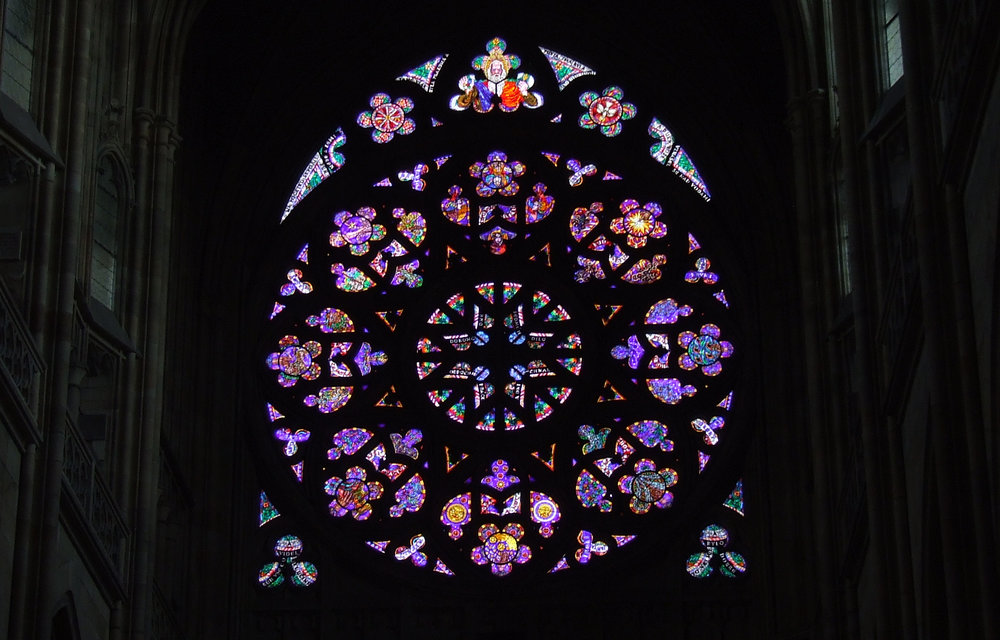
Stand in the Third Courtyard and look at the west façade before entering. The Rose Window — 10.4 metres in diameter — was designed by František Kysela and depicts the Creation of the World in 25 panels. The bronze doors below contain reliefs depicting the history of the cathedral and legends of St. Wenceslas and St. Adalbert — take 5 minutes to look at them. The twin towers are Neo-Gothic but the façade sculpture is exceptional.
The Nave — First Impression
Entering through the west portal, the nave opens up with a height of 33 metres. The impression of vertical space is immediate and intentional: Gothic architecture uses height to create the experience of approaching the divine. Let your eyes adjust for a moment before moving forward. The stained glass along the south wall of the nave — particularly the Mucha window — is best seen with morning or midday light from the south illuminating it from behind.
The Alfons Mucha Window
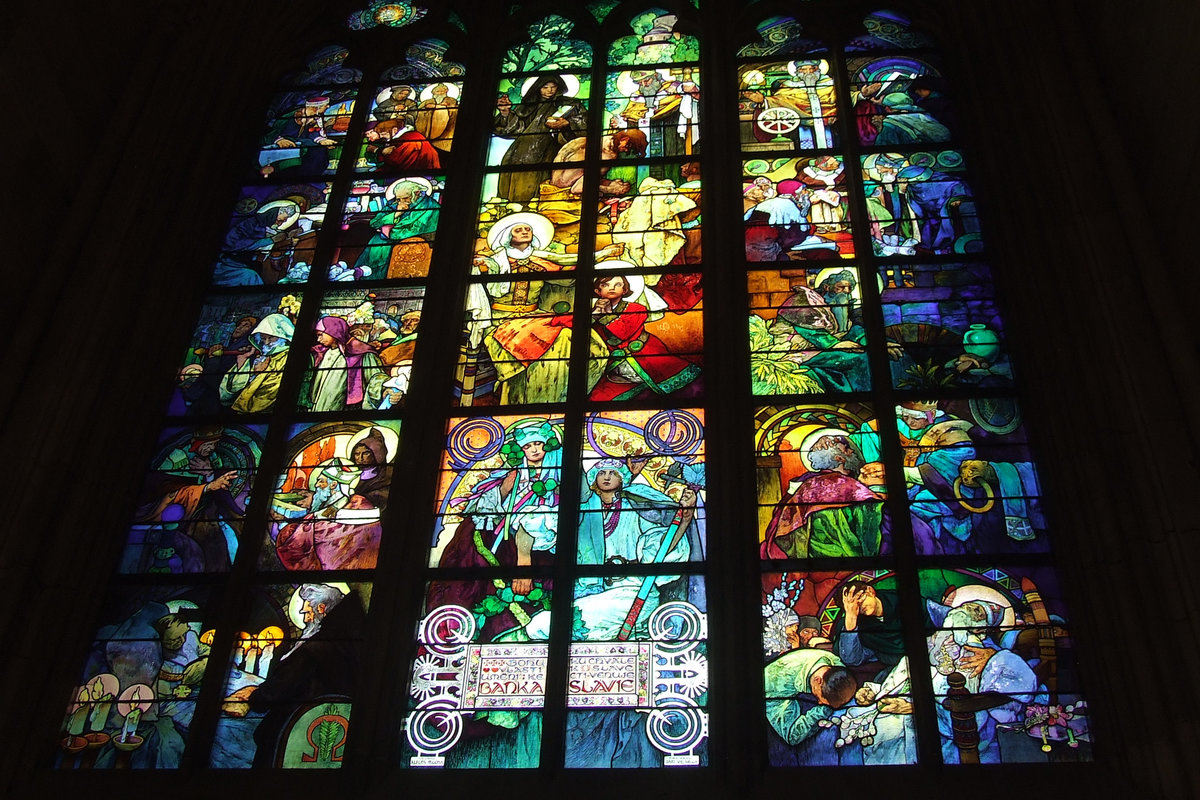
The third window on the left (north) side of the nave as you enter is the most photographed object in the cathedral and deservedly so. Alfons Mucha — the Czech Art Nouveau master better known for his commercial poster art — donated this window in 1931. It depicts the lives of the early Czech Christian saints Cyril and Methodius, the brothers who brought Christianity to the Slavic peoples in the 9th century. The style is unmistakably Art Nouveau in its decorative borders and figure treatment, but the subject matter is deeply patriotic: Mucha saw the window as a statement of Czech national and spiritual identity.
The best time to see the Mucha window is between 10am and 2pm when the south light enters from the opposite side and illuminates it from behind. In morning or evening light it is flatter. In direct midday sun the colours are at their most saturated.
The Chapels — Twenty-Eight Rooms of History
The cathedral contains 28 chapels, each with its own tombs, art and historical significance. These are the ones worth stopping for:
The Bohemian Crown Jewels
The Crown Chamber above the St. Wenceslas Chapel contains the most important historical objects in the Czech Republic: the Crown of St. Wenceslas, the royal orb, sceptre and coronation cross of Charles IV. They are locked behind a door with seven locks, each held by a different official — the President of the Republic, the Prime Minister, the Archbishop of Prague, the Chairman of the House of Deputies, the Chairman of the Senate, the Mayor of Prague and the Dean of the Cathedral Chapter. All seven must be present to open the door.
The crown jewels are displayed to the public very rarely — only on significant national anniversaries. The last public display was in 2018 for the centenary of Czechoslovak independence. You will almost certainly not see them; you can see the chamber door from the St. Wenceslas Chapel and know they are there.
The Crown of St. Wenceslas, made in 1347 for Charles IV, was designed to rest on the skull of St. Wenceslas in the chapel below between coronations. It is decorated with sapphires, rubies, emeralds and pearls. A Czech legend holds that anyone who places the crown on their head illegitimately will die within a year. Reinhard Heydrich, the Nazi Reich Protector of Bohemia, reportedly tried on the crown in 1941 and was assassinated in Prague in 1942. The story is probably apocryphal. It is also very Bohemian.
Tickets, Opening Hours & How to Enter
Getting In
The cathedral is included in the Prague Castle Circuit A ticket (CZK 250 adults) — this covers the cathedral, Old Royal Palace and Golden Lane. You cannot enter the interior of the cathedral without a ticket. The exterior (Third Courtyard, façade) is free. The South Tower is a separate paid entry (CZK 150) beyond the circuit ticket.
| Season | Mon–Sat | Sunday |
|---|---|---|
| Summer (April–October) | 9:00 – 17:00 | 12:00 – 17:00 |
| Winter (November–March) | 9:00 – 16:00 | 12:00 – 16:00 |
Which Prague Castle Ticket Includes St. Vitus Cathedral?
| Ticket | Cathedral | South Tower | Also includes | Price |
|---|---|---|---|---|
| Circuit A | ✓ | ✓ | Old Royal Palace · Golden Lane | CZK 250 |
| Circuit B | ✓ | ✓ | Everything in A + Powder Tower + Story of Prague Castle | CZK 350 |
| Circuit B + Lobkowicz | ✓ | ✓ | Everything in B + Lobkowicz Palace | CZK 645 |
| Go City Pass | ✓ | Depends | Castle + 30+ Prague attractions | from €69/day |
| Cathedral only | No separate ticket | — | Must buy a circuit ticket | — |
Insider Tips — Making the Most of Your Visit
- Arrive at 9am on a weekday. The cathedral fills from 10am and is genuinely crowded by 11am in summer. At 9am you will sometimes have the nave almost to yourself. The St. Wenceslas Chapel is particularly overwhelming in a crowd.
- The Mucha window needs south light. Between 10am and 2pm the light enters from the south and illuminates the window from behind. At 9am in winter the light is still flat. If the window is a priority, time your visit accordingly.
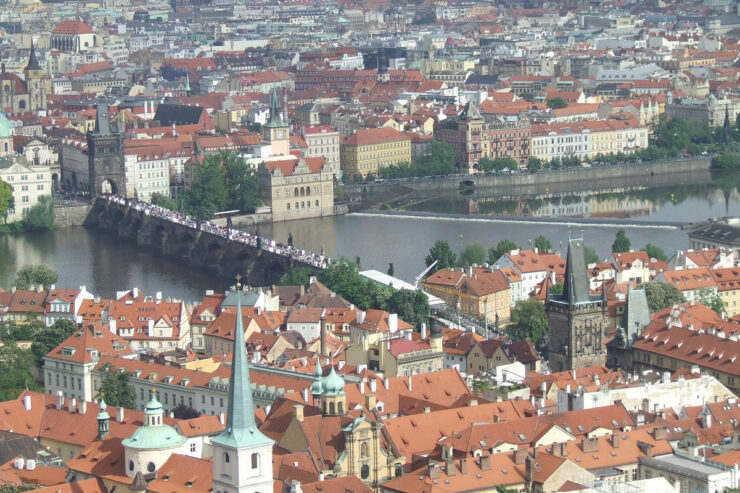
- Climb the South Tower. The 287 steps to the top are worth the effort — the view encompasses not just Prague but the Bohemian countryside beyond. The tower interior also shows the mixed Gothic-Renaissance-Baroque structure from the inside. Separate ticket (CZK 150), queue can form by mid-morning.
- Look up in the choir. Most visitors look at the chapels and the tombs and never look up. Parler’s net vaulting overhead is one of the great achievements of Gothic architecture. Stand under the choir, look straight up, and spend three minutes with it.
- The Royal Crypt. Accessible by a staircase in the nave floor, included in the circuit ticket. Most visitors walk past it. The crypt contains the sarcophagi of Bohemian kings including Charles IV — the man who built Prague into one of the great cities of medieval Europe. It is small, quiet and genuinely moving.
- Religious services. The cathedral holds regular services. During a service, the tourist areas are closed or restricted. Check the schedule at the entrance if you want to time around this — or time for it, since a sung mass in a Gothic cathedral is an extraordinary acoustic experience.
- Photography. Tripods are not permitted. Flash is not permitted in the St. Wenceslas Chapel. The best photography conditions are on overcast days when the stained glass glows evenly without harsh shadows.
Key stained glass locations. The Mucha window (north nave) and the Rose Window (west façade) are the highlights. The Golden Gate mosaic is on the south transept exterior.
More Prague Guides
- Prague Castle Complete Guide — tickets, circuits, Golden Lane and full planning advice
- Prague History Guide — Charles IV, the Hussites and the context behind the cathedral
- Charles Bridge Guide — also built by Peter Parler
- Jewish Quarter Guide
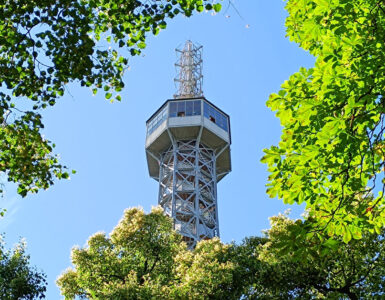
- Petřín Tower — best view of the cathedral from across the city
- 3 Days in Prague Itinerary
Frequently Asked Questions
Visit Prague Castle & St. Vitus Cathedral
Circuit A ticket includes the cathedral, Old Royal Palace and Golden Lane.
🎟 Compare Ticket Options → Skip-the-line + optional AudioGuide Castle tour with local guide Cathedral, Royal Palace & St. George’s Prague Castle full guide →This article contains affiliate links. If you book through them, HelloPrague earns a small commission at no extra cost to you. All recommendations are based on personal experience and honest assessment. Full disclosure here.

 Dan
Dan