The honest guide to Prague’s café scene — from Café Slavia where Havel drank to the best specialty roasters in Vinohrady, written by someone who has been drinking coffee in this city for thirty years
Prague has two distinct coffee cultures and most visitors only encounter one of them. The tourist-facing version is the grand café circuit — beautiful rooms, historic associations, coffee that is perfectly acceptable but not the point. The local version is the specialty coffee scene that has developed since 2010 — small roasters, serious baristas, single-origin beans, and a quality level that matches any city in Europe. Both have their place. Knowing which you want determines where you go.
The Kavárna Tradition — Why Prague Cafés Are Different
The Viennese coffeehouse tradition spread to Prague in the 18th century — the two cities were both part of the Habsburg Empire and shared an intellectual and café culture that was distinct from the French or Italian models. A Prague kavárna was a place where you could sit for three hours with a single coffee and a newspaper, using the café as an extension of your working or social life. The staff would not hurry you. The marble tables were designed for writing. The coat hooks were positioned to encourage a long stay.
This culture survived two world wars and forty years of Communism — partly because the Communist authorities needed somewhere for people to sit quietly and not cause trouble, partly because the kavárna tradition was so deeply embedded in Czech middle-class life that eliminating it would have been conspicuous. What changed under Communism was the quality: the grand cafés deteriorated, the menus shrank, the staff became indifferent. After 1989, the restoration began. Some cafés came back stronger than before. Others were converted into restaurants or tourist traps. The ones on this list survived or were restored to something worth visiting.
Historic Grand Cafés
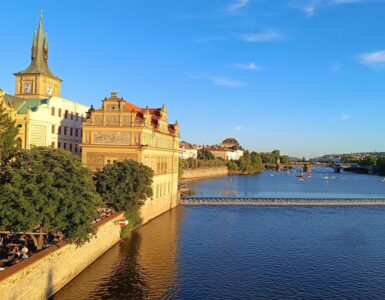
Café Slavia is the most historically charged café in Prague — possibly in Central Europe. On the corner of Smetanovo nábřeží and Národní třída, directly opposite the National Theatre, with views of the Vltava and Prague Castle from the window seats. Since 1884 it has been the meeting place of Czech writers, artists, politicians and dissidents: Rainer Maria Rilke drank here, Jaroslav Seifert wrote here, Václav Havel had his regular table here for decades.
The Communist period did not close Slavia — the regime needed it open as a safety valve for the intelligentsia. What the post-Communist period nearly did was worse: in 1993 the new owners closed it to convert it into a tourist restaurant. The protest was significant enough that Havel, then serving as President, personally intervened. It reopened in 1997 essentially unchanged. The Absinthe Drinker by Viktor Oliva — a large symbolist painting of a man at a café table with a green fairy — has hung on the wall since 1901.
The coffee is good rather than exceptional. The window seats with river views are what you come for. Order a coffee and a slice of cake, sit by the window, and understand why this room has mattered to Prague for 140 years.
Grand Café Orient is unique in the world — the only café designed and operating in the Czech Cubist style, on the first floor of Josef Gočár’s House of the Black Madonna, built in 1912. Czech Cubism applied the visual language of Cubist painting to architecture: faceted forms, prismatic surfaces, angled geometry. In the café, this means angled coat hooks, prismatic light fittings, geometric furniture — every detail designed as a unified Cubist whole.
The café was closed during the Communist era and restored in 2005 when the House of the Black Madonna became a museum of Czech Cubism. It is now one of the most architecturally distinctive café interiors in Europe, and the most specifically Prague café experience on this list — the building, the style and the history are all Czech and all irreplaceable. The coffee is good, the cakes are excellent, and the room is unlike anything else you will sit in.
The Café Imperial has the most spectacular interior of any café in Prague — a soaring Art Deco dining room with walls and ceiling entirely covered in hand-painted ceramic maiolica tiles in a Byzantine-inspired pattern. The effect is overwhelming in the best sense: every surface decorated, the ceiling arching above tables that feel deliberately small in comparison to the room around them. Built in 1914, closed for decades under Communism, and restored to its full original state in 2007.
This is the café to take someone who thinks they have seen Prague’s best interiors. The coffee is good, the breakfast menu is one of the best in the city, and the room justifies arriving specifically to sit in it. The hotel itself is worth staying in if the Art Deco aesthetic appeals — the rooms maintain the same standard as the café.
The Kavárna in the Municipal House — Prague’s greatest Art Nouveau civic building — is the most formally beautiful café interior in the city. Alphonse Mucha contributed to the decoration of the building; the café reflects his influence in its colours and ornamental detail. High ceilings, stained glass, marble, a room that was designed to express civic pride and does so without embarrassment.
Expensive by Prague standards — this is tourist-adjacent pricing — but the room earns it. Go for coffee and cake rather than a full meal; the experience is in the architecture rather than the menu. The Municipal House itself is worth visiting as a building: the Smetana Hall on the upper floor is where Czech independence was declared in 1918.
Café Savoy is not the most historically charged café on this list but it may be the most enjoyable — a beautifully restored 19th-century interior in Malá Strana with a breakfast and lunch menu that is consistently cited as the best in Prague. High ceilings, original plasterwork, natural light from large windows. The pastry counter at the front is the reason to arrive early: the viennoiserie is made in-house and sells out.
Go for weekend breakfast before 10am and you will find the room at its best — locals from Malá Strana alongside visitors who have been told by someone who knows. After 11am on weekends there is usually a queue. Worth it. The coffee is excellent — one of the few grand-style cafés in Prague where the coffee matches the room.
The café in the Grand Hotel Praha occupies the ground floor of one of the finest buildings on Old Town Square — directly facing the Astronomical Clock, with Týn Church’s Gothic spires filling the view from the window tables. The most expensive coffee on this list, priced for the address rather than the cup. Worth it exactly once, for the view. Order a coffee, sit at a window table, and accept that you are paying for one of the best views in Prague rather than for the caffeine.
Specialty Coffee — The Best in Prague
Prague’s specialty coffee scene developed seriously from around 2010 — later than Vienna or Berlin but with the focused intensity of a city making up for lost time. The best roasters and baristas here are operating at a level that matches any European city, and the prices (CZK 55–85 for an espresso-based drink) are significantly lower than London, Amsterdam or Copenhagen for equivalent quality.
Onesip is the specialty coffee bar most consistently cited by baristas and coffee professionals as the best in Prague — a tiny counter operation in Old Town with minimal seating and maximum focus on the cup. The espresso uses beans from carefully selected roasters including Round Hill and Candy Cane; the extraction is precise. This is not a place to sit and work for two hours — it is a place to drink a seriously good espresso, understand what that means, and leave having experienced the top of Prague’s coffee quality. CZK 60–70 for an espresso.
Super Tramp Coffee is in a hidden courtyard in New Town — the kind of place that requires a local tip or deliberate navigation to find, which is part of its appeal. A vinyl turntable plays records, the coffee is excellent (rotating single-origins, careful filter brewing), and the small terrace is one of the better places in the city to sit with a coffee when the weather permits. The crowd is a specific Prague mix of locals who care about coffee and international visitors who have done their research. CZK 65–80 for filter coffee.
Vinohrady Cafés
Vinohrady has more independent cafés per block than any other neighbourhood in Prague — a combination of the resident demographic (educated, design-conscious, coffee-literate) and the Art Nouveau streetscape that provides natural café spaces in almost every building. The three below are the ones worth seeking out specifically.
La Boheme is the most visually distinctive café in Vinohrady — a double-height space with a spiral staircase, own-roast beans, and an interior that manages to feel both carefully designed and genuinely welcoming. On Mánesova, Vinohrady’s best street for eating and drinking, within walking distance of both metro stations. The coffee uses beans roasted in-house, which gives consistency across the menu. Good for a long working morning or a leisurely afternoon — the space accommodates both without feeling like it is optimised for either.
Dos Mundos is a proper roastery-café — the roasting happens on site, the baristas know the beans, and the menu is organised around pour-over and filter methods rather than milky espresso drinks. One of the most serious coffee operations in Prague for those who care about where the bean comes from and how it was processed. Barista courses are available if you want to go deeper. Korunní street puts you in the heart of Vinohrady, five minutes from Náměstí Míru.
Version Coffee is the neighbourhood café that Vinohrady residents use most — own-roast beans, consistently good espresso and filter, and the atmosphere of a place that is not trying to be discovered. The crowd is overwhelmingly local; the prices reflect the neighbourhood rather than a tourist premium. Near Náměstí Míru, close to Vinohradský Pivovar brewery. The right café for the right kind of Prague morning — quiet, well-made coffee, no performance.
How to Order Coffee in Prague — What the Menu Actually Means
- Turecká káva — Turkish coffee: finely ground coffee in hot water, unfiltered. Still found in traditional kavárnas. Strong, bitter, with grounds in the cup. Wait for the grounds to settle before drinking.
- Překapávaná / filtrovaná — filter/drip coffee. The default in specialty cafés. Ask if they are pouring to order (V60, Chemex) or batch brewing.
- Espresso — same as elsewhere. Single or double (dvojité).
- Vídeňská káva — Viennese coffee: espresso with whipped cream. The grand café default. Order this at Café Slavia.
- Cappuccino / flat white / latte — standard international terms, understood everywhere.
- Mléko — milk. If you want your espresso drink with less milk: “méně mléka, prosím.”
- S sebou — to go. Prague cafés traditionally expect you to sit, but takeaway is available everywhere now.
Guided Café Tour — The Best Way to Cover the Ground
A guided early morning walking tour visiting four of Prague’s most important historic cafés, with Czech breakfast tastings and coffee at each stop. The tour meets at the Hotel Imperial — one of the stops, and a good starting point for the Art Deco maiolica interior — and ends on Národní třída near the National Theatre and Café Slavia. The guide covers the history of each café, the people who drank in them (Kafka, Einstein connections are specifically mentioned), and the Czech breakfast culture alongside the coffee.
This is the most efficient way to cover Prague’s historic café circuit in a single morning — four cafés, breakfast included, local guide with the stories, and the Old Town streets at their quietest before the day begins. Well-reviewed for guide quality and café selection.
Quick Reference — Where Each Café Is
- Café Slavia — Smetanovo nábřeží, Old Town edge · Opposite National Theatre · River views
- Grand Café Orient — Ovocný trh, Old Town · House of the Black Madonna · 1st floor
- Café Imperial — Na Poříčí, New Town · Near Náměstí Republiky metro
- Kavárna Obecní Dům — náměstí Republiky, Old Town · Municipal House ground floor
- Café Savoy — Vítězná, Malá Strana · Near Legions Bridge · 5 min from Charles Bridge
- Grand Hotel Praha Café — Old Town Square · Directly facing Astronomical Clock
- Onesip Coffee — Skořepka, Old Town · Tiny, counter only · Best espresso in Prague
- Super Tramp Coffee — Hidden courtyard, New Town · Worth finding
- La Boheme Café — Mánesova, Vinohrady · Spiral staircase · Own roastery
- Dos Mundos — Korunní, Vinohrady · Own roastery · Pour-over focus
- Version Coffee — Náměstí Míru area, Vinohrady · Local neighbourhood choice
More Prague Guides
- Best Restaurants in Prague — where locals actually eat
- Hotels in Vinohrady — stay in the neighbourhood with the best café scene
- Prague Beer & Pub Guide — the other side of Czech café culture
- Prague for First-Timers — everything before your first visit
- Prague History Guide — the story behind the cafés and the city
- Old Town Square Guide — the neighbourhood where most of the grand cafés sit
- Prague Communist History — why Café Slavia’s closure in 1993 mattered
- Best Things to Do in Prague — the full activity guide
Frequently Asked Questions — Prague Coffee
Experience Prague’s Café Culture
The guided morning café tour covers four historic venues with breakfast — the most efficient single morning in Prague’s kavárna world.
Early Bird Café Tour → Stay at Café Imperial Hotel → Prague Food Tour →This article contains affiliate links. If you book through them, HelloPrague earns a small commission at no extra cost to you. All recommendations are based on personal experience and honest assessment. Full disclosure here.

 Dan
Dan
