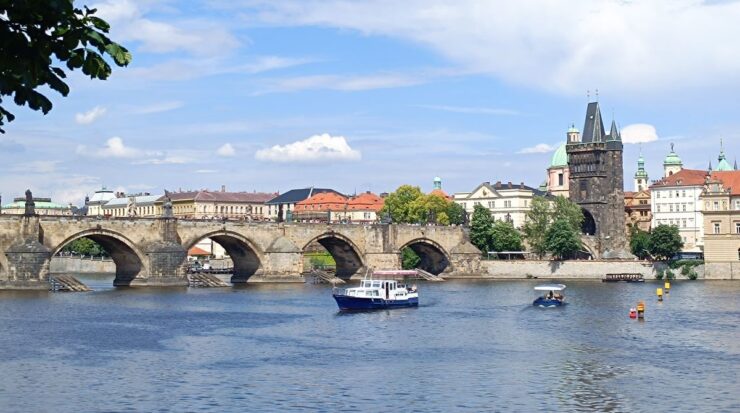
Dan Brown’s Prague — The Real Locations from The Secret of Secrets (2026)
Charles Bridge at dawn, the Klementinum Baroque library, Petřín Tower, the Golem’s quarter and the Cold War bunker beneath Folimanka Park — every real Prague location from the 2025 Robert Langdon thriller, mapped and explained
Dan Brown’s The Secret of Secrets (2025) is set entirely in Prague. The main locations are: Four Seasons Hotel (Langdon’s base), Charles Bridge (opening scene), Klementinum (the burning manuscript), Petřín Tower (the coded message), Jewish Quarter (the Golem connection) and Folimanka Park (the underground Threshold complex). There is an official Dan Brown Prague walking tour covering all key locations in 3 hours. Self-guided itinerary takes 2 days.
When Dan Brown chose Prague as the setting for The Secret of Secrets — his sixth Robert Langdon thriller, published in September 2025 — he did not choose it for the postcards. He chose it because Prague is genuinely one of the most layered, symbolically dense cities in Europe: a place where Baroque libraries hide astronomical towers, Cold War bunkers sit under public parks, and the Golem walks out of Jewish legend into a modern thriller plot. This guide maps every real Prague location from the novel, explains what happens there in the book, and tells you exactly how to visit.
All Secret of Secrets Prague Locations — Map
All eight major locations cluster in a compact area of central Prague — most are walkable from each other in under 15 minutes. Click any stop on the map or in the sidebar to zoom in.
The Secret of Secrets — Prague Locations
Click any stop to zoom in · OpenStreetMap / CartoDB
Four Seasons → Charles Bridge → Klementinum (10 min walk). Jewish Quarter → Petřín Tower (30 min by tram + funicular). Folimanka Park is in Vinohrady, 25 min by tram from the centre.
Robert Langdon and Katherine Solomon are staying at the Four Seasons when the novel opens. The morning after her consciousness lecture, Langdon sees the strangely dressed woman on Charles Bridge from near the hotel. After the bomb threat and hotel evacuation, Czech intelligence detains them here. The Four Seasons is the place they keep returning to — and it is where Nagel brings them at the novel’s close before the US Embassy intervention.
The Four Seasons Prague occupies a Neo-Classical palace directly on the Vltava riverbank — looking across the water to Malá Strana and Prague Castle. The riverside position Brown chose for Langdon’s base is deliberate: from the terrace, Charles Bridge is visible to the south and Prague Castle dominates the western skyline. It is exactly the kind of location that signals to a Langdon reader that the city itself is a character in the plot.
The riverside terrace, where you can have breakfast looking at the castle and the bridge simultaneously, is the correct starting point for the itinerary. Langdon’s opening chapters describe morning light on the Vltava. Go before 8am and the light and the quiet will make more sense of Brown’s atmospheric opening than any amount of reading about it.
The morning after Katherine Solomon’s lecture, Langdon sees a strangely dressed woman on Charles Bridge — an encounter that reminds him of an ominous dream Solomon had the previous night and triggers the hotel evacuation. The woman is later revealed to be connected to the Threshold organisation. Charles Bridge is where the novel’s tension first appears: an ordinary morning crossing that becomes the first sign something is deeply wrong.
Brown did not choose Charles Bridge by accident. The 516-metre Gothic crossing — built in 1357, lined with 30 Baroque statues, the stage for public executions and royal processions for centuries — is exactly the kind of location that carries the historical weight his plots require. The bridge has its own dark history: the severed heads of 27 executed Czech lords were displayed on the Old Town tower for a decade after 1621. In early morning fog, the effect is precisely what Brown describes.
Walk the bridge from the Old Town end — the same direction Langdon approaches from the Four Seasons — before 7am. The statues are yours alone at that hour. The castle emerges ahead in the morning light. St. John of Nepomuk, thrown from this bridge on the orders of King Wenceslas IV in 1393, stands on the south side with five golden stars around his head. The brass relief panel at his base is worn bright gold by centuries of hands — Prague’s most practiced superstition.
Langdon crosses Old Town Square multiple times in the novel’s middle section — it functions as the geographical centre of his Prague, the space he keeps returning to between the Four Seasons, the Klementinum and the Jewish Quarter. The Astronomical Clock appears repeatedly as a symbol of time pressure — the mechanism that counts down while Langdon is still solving the puzzle.
Old Town Square is the medieval heart of Prague — surrounded by Gothic, Baroque and Renaissance buildings, the Astronomical Clock on the Old Town Hall tower showing medieval cosmology in working mechanism. Brown uses the clock as a recurring motif throughout the novel: the apostles processing on the hour while Langdon races against a deadline.
Langdon receives a coded message from Katherine leading him to the Klementinum, where she has been hidden. With Czech intelligence officer Pavel closing in, Langdon is forced to burn the last physical copy of Katherine’s manuscript — triggering the fire alarms as a distraction to allow their escape. One of the novel’s most dramatic scenes: a Harvard professor of symbology deliberately burning a book inside one of the most beautiful libraries in Europe, in a room built specifically to house sacred knowledge.
The Klementinum is the second-largest complex of buildings in Prague after the castle — a former Jesuit college founded in 1556, expanded over two centuries into a compound of churches, courtyards, libraries and towers. Brown chose it for the obvious reason: it is exactly what a secret repository of knowledge looks like. And it is five minutes’ walk from Charles Bridge.
The Baroque Library Hall is the scene of the manuscript burning — a two-storey oval room with ceiling frescoes depicting the Temple of Wisdom, gilded galleries, original 18th-century globes on the reading tables and the particular smell of 400 years of books. It is one of the most beautiful interior spaces in Central Europe. Standing in it after reading Brown’s burning scene gives the location an additional charge that most visitors — who come without the novel’s context — do not bring.
The Astronomical Tower — accessible on the same tour — is the building from which Prague’s daily time signal was given from 1842 onwards. Brown uses the tower throughout the novel as a symbol of Prague’s history as a centre of astronomical and scientific knowledge. The view from the top takes in the entire Old Town roofscape.
The character who calls himself the Golem in the novel has Dissociative Identity Disorder — his protective alter-ego emerges when the person he cares for is threatened, enacting the original legend’s purpose through a contemporary psychological framework. Brown draws directly on the most famous legend of Prague’s Jewish Quarter: the Golem of Prague, created by Rabbi Judah Loew ben Bezalel in the 16th century from the clay of the Vltava riverbank to protect the Jewish community. The novel uses the Jewish Quarter’s physical spaces — the synagogues, the cemetery, the narrow lanes of Josefov — as the thematic backdrop to the Golem character’s psychology.
The Jewish Quarter contains six synagogues and the Old Jewish Cemetery — one of the most significant Jewish heritage sites in Europe. The Old-New Synagogue, built in 1270, is the oldest surviving synagogue in Central Europe and is directly connected to the Golem legend — Rabbi Loew’s remains of the Golem are said to be stored in the attic, inaccessible and never removed. The Old Jewish Cemetery, where Rabbi Loew is buried, has 12,000 gravestones layered over 100,000 burials. Standing at his grave while holding Brown’s novel is one of the more specific reading experiences Prague offers.
Langdon receives a coded message at Petřín Tower that leads him to Katherine’s location in the Klementinum. Brown uses the tower’s height and its panoramic view over the city as the moment of maximum disorientation — Langdon can see the entire city from above but still cannot see what is directly in front of him. The tower functions as the novel’s midpoint: the place where everything Langdon has learned so far becomes suddenly, terrifyingly coherent.
Petřín Tower is a 60-metre steel tower on Petřín Hill in Malá Strana — built for the 1891 Prague Jubilee Exhibition in deliberate homage to the Eiffel Tower, one-fifth the scale. The hill itself is covered in orchards and gardens, reachable by funicular from Újezd. The view from the tower’s observation deck — the entire city laid out below, the Vltava curving south, Old Town and the castle visible simultaneously — is one of the highest accessible viewpoints in Prague.
The fictional Threshold underground complex — the secret intelligence operation that drives the novel’s second half — is located beneath Folimanka Park in Vinohrady. Langdon and Solomon are brought here against their will and find a facility that is both technologically advanced and historically rooted in the Cold War infrastructure of Communist Prague. The underground is the novel’s literal underworld: the place where what has been hidden beneath the city’s surface finally becomes visible.
The Folimanka Civil Protection Shelter is entirely real. It is a Cold War-era civil defence bunker built beneath Folimanka Park during the Communist period — one of several such structures beneath Prague’s public spaces, some of which are still classified. Brown used this real underground infrastructure as the basis for his fictional Threshold complex. The park itself — a quiet neighbourhood green space in Vinohrady — gives no surface indication of what lies beneath it. That disjunction between the ordinary surface and the extraordinary underground is precisely what Brown is writing about.
The Prague ghost tour covers the Golem legend in the Jewish Quarter, the darker history of Charles Bridge and the medieval secrets of Old Town — all of which feed directly into Brown’s thematic world. The tour covers the same physical spaces as the Dan Brown itinerary but at night, with guides who specialise in the supernatural and historical undercurrents that Brown uses as his raw material.
Do the Dan Brown daytime itinerary and then the ghost tour the same evening. The combination — the same streets, the same legends, the same architectural spaces in the dark — makes the novel’s atmosphere genuinely vivid in a way that daylight visits alone cannot achieve. The Golem story is substantially better understood at 9pm in the Jewish Quarter than at 10am.
The Official Dan Brown Prague Walking Tour
If you want a guided version of this itinerary — with a specialist guide who knows the novel, the history and the specific details Brown drew on — the official Prague Dan Brown Walking Tour covers all the key Secret of Secrets locations in approximately 3 hours.
Self-Guided vs Guided Tour — Which Is Right for You?
| Feature | Self-Guided (This Guide) | Official Walking Tour |
|---|---|---|
| Cost | Free | Paid (~€20–30) |
| Duration | 2 days at your own pace | 3 hours — all key locations |
| Flexibility | Complete — stop when you want | Fixed route & schedule |
| Historical context | This guide + your own research | Expert guide — novel’s research explained live |
| Hidden details | What you notice yourself | Guide knows what Brown drew on — you see it too |
| Best for | Independent travellers & return visitors | First-time visitors & serious fans of the novel |
Stay Like Robert Langdon — Hotels in the Novel
Langdon stays at the Four Seasons throughout The Secret of Secrets. Brown’s choice was not random — the hotel’s position on the Vltava, with Charles Bridge visible from the terrace and Prague Castle on the horizon, is the specific view that frames the novel’s opening chapters. Two other hotels in the same area put you inside the same atmospheric world.
Explore Every Location Further
- Charles Bridge Complete Guide — the opening scene location · every statue · the dark history
- Jewish Quarter (Josefov) Guide — the Golem legend · synagogues · Rabbi Loew’s grave
- Petřín Tower & Funicular Guide — where Langdon decodes Katherine’s message
- Old Town Square Guide — the Astronomical Clock · the recurring crossing point
- Prague Castle Guide — the backdrop to Langdon’s entire Prague stay
- Prague Hidden Gems — the less-visited spaces Brown draws on
- 3 Days in Prague Itinerary — how to fit the Dan Brown locations into a full Prague stay
- Best Hotels in Prague — including the Four Seasons where Langdon stays
Frequently Asked Questions — Dan Brown’s Prague
Walk Prague Through Dan Brown’s Eyes
Start at the Four Seasons at dawn. Walk to Charles Bridge before the city wakes up. Then book the ghost tour for that evening — the same streets, the same legends, at night. Prague explains itself differently in the dark.
Book Dan Brown Walking Tour → Book Ghost Tour — same evening → Book the Four Seasons →This article contains affiliate links. If you book through them, HelloPrague earns a small commission at no extra cost to you. Location details are verified against the published novel and public sources. Full disclosure here.

 Dan
Dan